The Complete Guide to Indie Developer Tech Stack in 2025
A comprehensive guide for indie developers on choosing the right tech stack in 2025. From AI-first development to edge computing, learn the best practices for building successful products.
The Complete Guide to Indie Developer Tech Stack in 2025
As an indie developer, choosing technology is no longer just a technical decision—it's a strategic choice that can make or break your project. After years of hands-on experience and observation, I've put together a comprehensive tech stack selection strategy specifically for indie developers. This guide will help you avoid common pitfalls and quickly build successful products.
Core Challenges of Indie Development
🎯 Managing Everything with Limited Resources
Time pressure: Need to validate your business model within a limited timeframe
Budget constraints: Usually zero income initially, so every dollar counts
Wearing multiple hats: One person handling frontend, backend, design, marketing, and more
Decision fatigue: Every tech choice impacts your project's long-term success
🚀 Balancing Speed and Stability
Indie developers need to find the sweet spot between rapid experimentation and system reliability. Choose technologies that are too complex, and you'll slow down your development speed. Go too simple, and you might hit roadblocks when your project grows.
Frontend Stack: Modern and AI-Driven
Next.js: The Best Choice for Full-Stack Development
Next.js 15+ (App Router) has become the go-to framework for indie developers building AI SaaS applications:
🔥 Key Advantages:
App Router architecture: Better performance and developer experience
Full-stack capabilities: API Routes enable unified frontend and backend development
Edge computing support: Native support for Edge Functions and Streaming UI
AI-friendly: Perfect integration with Vercel AI SDK
⚠️ Important Deployment Considerations
Cloudflare Pages Limitations:
Incomplete support for complex Next.js applications
Limited Server-side rendering (SSR) functionality
Some Next.js features don't work properly
Difficult debugging with unclear error messages
🚀 Recommended Solution: OpenNext.js + Cloudflare Workers
Based on real-world experience, a better approach is using OpenNext.js to deploy Next.js apps to Cloudflare Workers:
Benefits Comparison:
✅ Complete Next.js support: Including SSR, API Routes, Middleware, etc.
✅ Better performance: Leverages Cloudflare's global edge network
✅ Cost-effective: Cheaper than Vercel, more reliable than Cloudflare Pages
✅ Great developer experience: Maintains full Next.js development experience
UI Frameworks: Modern Design Systems
2025 UI Component Library Comparison:
| Component Library | Features | Use Cases | AI Integration | Rating |
| shadcn/ui | Highly modular, Radix UI based | Modern SaaS, high customization | ⭐⭐⭐⭐⭐ | ⭐⭐⭐⭐⭐ |
| Mantine UI | Feature-rich, ready to use | Rapid prototyping, enterprise apps | ⭐⭐⭐⭐ | ⭐⭐⭐⭐ |
| Radix UI | Unstyled, fully customizable | Design system building | ⭐⭐⭐ | ⭐⭐⭐⭐ |
| Chakra UI | Simple to use, themeable | Small projects, MVPs | ⭐⭐⭐ | ⭐⭐⭐ |

TailwindCSS's Unique Value:
AI-friendly: Works exceptionally well with ChatGPT and GitHub Copilot
Consistency: Avoids CSS conflicts and naming issues
High efficiency: Reduces time switching between CSS files
AI Integration: Core Competitive Advantage in 2025
🤖 AI-First Development Strategy
In 2025, AI integration has shifted from "nice to have" to "must have." Indie developers need to build AI features into their products to stay competitive.
Core AI Toolstack
LLM Provider Selection Strategy
| Provider | Use Cases | Cost | Latency | Rating |
| Together AI | Batch inference, cost-sensitive | 💰 | ⭐⭐⭐⭐ | ⭐⭐⭐⭐⭐ |
| OpenAI | General chat, creative generation | 💰💰💰 | ⭐⭐⭐⭐⭐ | ⭐⭐⭐⭐ |
| Anthropic | Complex reasoning, safety | 💰💰 | ⭐⭐⭐⭐ | ⭐⭐⭐⭐ |
| Cloudflare Workers AI | Edge inference, privacy protection | 💰 | ⭐⭐⭐⭐⭐ | ⭐⭐⭐⭐ |

AI Feature Development Patterns
1. Chatbots (Basic)
Customer service automation
Product recommendations
User onboarding
2. Content Generation (Intermediate)
Copywriting
Code generation
Image processing
3. Intelligent Analysis (Advanced)
Data insights
Predictive analytics
Personalized recommendations
AI Monitoring and Cost Control
Key Monitoring Metrics:
💰 Cost tracking: Real-time AI API expense monitoring
⏱️ Latency analysis: Response time and performance optimization
🔍 Usage patterns: User behavior and feature adoption rates
⚠️ Error monitoring: API failures and exception handling
2025 AI Trends
Edge AI Deployment
Inference tasks running on edge nodes
Platforms like Cloudflare Workers AI becoming mainstream
Hyper-Personalization
Real-time user behavior analysis
Dynamic content adjustment
Smart interface adaptation
No-Code/Low-Code AI Integration: Lowering Technical Barriers 🔧
Stack AI: Visual AI workflow builder Zapier AI: Natural language workflow automation Visual LangChain Orchestration: Drag-and-drop AI Agent building
Security & Compliance: New Challenges in the AI Era
AI-Driven Threat Detection:
Real-time security monitoring
Anomaly behavior pattern detection
AI-generated content identification
Explainable AI (XAI) Implementation:
AI decision explanation
Audit trail recording
Compliance assurance
Backend Architecture: Edge-First Serverless Strategy
Cloudflare Workers + Hono.js: The Perfect Modern API Combination
Hono.js: Web Framework Designed for Edge Computing
🚀 Key Advantages:
Lightning performance: Optimized for Edge Runtime, startup time < 1ms
Lightweight: Complete framework at only ~31KB
TypeScript native: Full type safety support
Multi-runtime compatible: Supports Cloudflare Workers, Deno, Node.js
Performance Comparison:
| Framework | Cold Start | Memory Usage | Bundle Size | Edge Support |
| Hono.js | < 1ms | ~10MB | 31KB | ⭐⭐⭐⭐⭐ |
| Express.js | ~100ms | ~50MB | 500KB+ | ❌ |
| Fastify | ~50ms | ~30MB | 200KB+ | ⭐⭐ |
| Next.js API | ~200ms | ~80MB | 1MB+ | ⭐⭐⭐ |

Hybrid Architecture Strategy
Service Distribution Strategy:
Edge Layer: Authentication, caching, simple CRUD → Hono.js + D1
Compute Layer: Complex business logic, AI inference → Cloudflare Workers AI
State Layer: Real-time features, session management → Durable Objects
Data Layer: Relational data, analytics → Neon Postgres
Storage Layer: Files, media → Cloudflare R2
Cloudflare Durable Objects: Edge State Management 🌟
Durable Objects Advantages:
Global uniqueness: Each object has only one instance globally
Strong consistency: Ensures state consistency and persistence
Edge distribution: Automatically migrates to the nearest data center to users
WebSocket support: Perfect support for real-time communication
Database Selection: Multi-Tier Data Strategy
Neon: The New Serverless Postgres Standard in 2025 🌟
🚀 Outstanding Advantages:
Instant branching: Git-like database branch management, perfect for development workflows
Auto-scaling: Automatic scaling from zero to any size
Edge optimization: Perfect integration with Cloudflare Workers
Cost-effective: True pay-as-you-go, zero cost when idle
Comparison with Other Solutions:
| Database Solution | Cold Start | Auto-scaling | Branching | Edge Support | Price |
| Neon | Instant | ⭐⭐⭐⭐⭐ | ⭐⭐⭐⭐⭐ | ⭐⭐⭐⭐⭐ | $0.102/GB |
| Supabase | ~2s | ⭐⭐⭐ | ❌ | ⭐⭐⭐ | $0.125/GB |
| PlanetScale | ~1s | ⭐⭐⭐⭐ | ⭐⭐⭐ | ⭐⭐ | $0.30/GB |
Drizzle ORM: Perfect Partner for Edge Computing
Compared to Prisma, Drizzle is better suited for serverless environments, supporting vector search and pgvector integration.
Data Storage Architecture Strategy
Multi-tier Storage Solution:
Hot data - Cloudflare KV (edge cache)
Warm data - Neon Postgres (structured data)
Cold data - Cloudflare R2 (file storage)
Distributed Caching Strategy
Redis Alternative - Upstash Redis:
Smart caching for AI responses
Pay-as-you-go pricing model
Edge network optimization
Authentication & Authorization: Modern Identity Management
Clerk: The New Standard for SaaS Authentication in 2025 🌟
🚀 Key Advantages:
Modern UI: Beautiful authentication interfaces out of the box
Seamless integration: Perfect compatibility with Next.js and React
Enterprise features: 2FA, SSO, user management dashboard
Developer experience: Simple API with rich customization options
Authentication Solution Matrix (2025 Update)
| Solution | Use Cases | Cost | AI Integration | Enterprise Features | Rating |
| Clerk | Modern SaaS apps | $25/month+ | ⭐⭐⭐⭐⭐ | ⭐⭐⭐⭐⭐ | ⭐⭐⭐⭐⭐ |
| WorkOS | Enterprise SSO | $99/month+ | ⭐⭐⭐ | ⭐⭐⭐⭐⭐ | ⭐⭐⭐⭐ |
| Supabase Auth | Full-stack apps | $25/month+ | ⭐⭐⭐ | ⭐⭐⭐ | ⭐⭐⭐⭐ |
| Auth.js | Simple social login | Free | ⭐⭐ | ⭐⭐ | ⭐⭐⭐ |
WorkOS: Professional Choice for Enterprise Authentication 🏢
WorkOS Enterprise Advantages:
Single Sign-On (SSO): Supports SAML, OIDC, and other standard protocols
Directory Sync: Automatic enterprise user directory synchronization
Multi-Factor Authentication: Built-in MFA support
Audit Logs: Complete user activity tracking
Compliance: SOC 2, GDPR, and other compliance support
Communication & Email: Modern Messaging
Resend: Next-Generation Email Platform 🌟
Resend has become the preferred email solution for serverless applications in 2025:
Core Features:
Modern API design
React Email template integration
Perfect serverless support
Detailed analytics and monitoring
Mailchannels: Email Solution for Cloudflare Workers
For fully Cloudflare-based architectures, Mailchannels provides native email support.
Communication Tool Selection Strategy
Email Service Comparison:
| Service | Use Cases | Cost | Serverless Support | Rating |
| Resend | Modern apps, React integration | $20/month+ | ⭐⭐⭐⭐⭐ | ⭐⭐⭐⭐⭐ |
| Mailchannels | Cloudflare ecosystem | $0.001/email | ⭐⭐⭐⭐⭐ | ⭐⭐⭐⭐ |
| Twilio SendGrid | Enterprise, high volume | $19.95/month+ | ⭐⭐⭐ | ⭐⭐⭐ |
| AWS SES | AWS ecosystem | $0.10/1000 emails | ⭐⭐⭐⭐ | ⭐⭐⭐ |
Data Analytics & Monitoring: Observability in the AI Era
Helicone: Professional LLM Application Monitoring 🌟
Helicone is specifically designed for AI applications, providing:
LLM cost tracking
Latency monitoring
Error analysis
Usage pattern insights
Modern Analytics Toolstack
Privacy-First Website Analytics
Recommended Solutions:
Umami: Open-source, self-hosted, privacy-friendly
Plausible: Lightweight, GDPR compliant
Microsoft Clarity: Free user behavior analysis
User Experience Monitoring
Core Tools:
LogRocket: Session replay and performance monitoring
Sentry: Error tracking and performance monitoring
Helicone: Specialized AI application monitoring
Payment Integration: Global Payment Strategy
⚠️ Major Industry Change: LemonSqueezy Acquired by Stripe
Important Changes at the End of 2024: LemonSqueezy has been acquired by Stripe, which is a significant turning point for indie developers.
New Payment Solution Selection Strategy
Creem.io: New Developer-Friendly Choice 🌟
Outstanding Features:
Low barriers: Individual developers can register directly
Transparent pricing: Fixed rates, no hidden fees
Modern API: RESTful API with comprehensive documentation
Multi-currency support: Supports mainstream cryptocurrencies and fiat
2025 Payment Solution Selection Matrix
| Payment Provider | Individual Developers | Enterprise Users | China Support | API Friendliness | Overall Rating |
| Stripe | ❌ | ⭐⭐⭐⭐⭐ | ❌ | ⭐⭐⭐⭐⭐ | ⭐⭐⭐⭐ |
| Paddle | ⭐⭐ | ⭐⭐⭐⭐⭐ | ⭐⭐⭐ | ⭐⭐⭐⭐ | ⭐⭐⭐⭐ |
| Creem.io | ⭐⭐⭐⭐⭐ | ⭐⭐⭐ | ⭐⭐⭐⭐ | ⭐⭐⭐⭐⭐ | ⭐⭐⭐⭐⭐ |
| LemonSqueezy | ⚠️ Uncertain | ⚠️ Uncertain | ⭐⭐⭐ | ⭐⭐⭐ | ⚠️ Wait and see |
Updated Practical Recommendations
New Strategy for 2025:
Have overseas company → First choice Stripe, backup Paddle
Individual developers → First choice Creem.io, backup Paddle
Mainly Chinese users → Creem.io + local Alipay/WeChat
B2B SaaS → Paddle (tax advantages) + Stripe (brand trust)
Digital product creators → Lemon8/Gumroad
Deployment & Operations Automation
Next.js Deployment Best Practices
Real Migration Experience Sharing:
Benefits from migrating from Cloudflare Pages to OpenNext.js:
Performance improvement: SSR response time reduced from ~500ms to ~150ms
Feature completeness: All Next.js features work properly
Debugging experience: More detailed error logs and consistency with local development environment
Cost control: Approximately 70% savings in deployment costs compared to Vercel
Deployment Strategy Comparison
| Deployment Solution | Use Cases | Performance | Cost | Complexity |
| Vercel | Rapid prototyping, team collaboration | ⭐⭐⭐⭐⭐ | 💰💰💰 | ⭐ |
| OpenNext.js + CF Workers | Production environment, cost-sensitive | ⭐⭐⭐⭐⭐ | 💰 | ⭐⭐⭐ |
| Cloudflare Pages | Static websites | ⭐⭐⭐⭐ | 💰 | ⭐⭐ |
| Railway/Render | Complex backend logic | ⭐⭐⭐⭐ | 💰💰 | ⭐⭐⭐ |
Cost Optimization Strategy
Maximizing Free Tier Resources
Free Resource Checklist:
Vercel: 100GB bandwidth/month
Supabase: 500MB database + 500K API calls
Cloudflare: 100K Workers requests/day
GitHub: Unlimited private repositories
Resend: 3,000 emails/month
Cost Alerting Mechanisms
Set up budget alerts to avoid unexpected charges:
Cloud provider billing alerts
Third-party cost monitoring tools
Regular cost analysis and optimization
2025 Latest Non-Serverless Solutions Deep Dive
🚀 Modern Container Platform Rising Stars
Zeabur: Next-Generation Developer Platform
Core Advantages:
Zero-configuration deployment: Support one-click deployment from Git repositories, automatically recognizing tech stacks
Edge network: Based on global CDN, providing low-latency access
Developer-friendly: Rich preset templates and one-click service installation
Transparent billing: Pay-as-you-go with no hidden fees
Railway: Developer Experience Benchmark
2025 New Features:
Template marketplace: One-click deployment of popular open-source projects
Environment branching: Git branch-like environment management
Real-time collaboration: Team members can view deployment status in real-time
Smart scaling: Automatic resource adjustment based on traffic
Render: Ideal Choice for Full-Stack Applications
Outstanding Features:
Blueprint functionality: Infrastructure as code, version-controlled deployment configuration
Preview environments: Automatically create preview environments for each Pull Request
Background jobs: Built-in Cron jobs and Worker queues
Database backups: Automated database backup and recovery
🏗️ Modernized Infrastructure as a Service (IaaS)
Hetzner: Europe's Cost-Performance King
Suitable Scenarios:
Applications with primarily European users
AI/ML projects requiring substantial computing resources
Long-running background services
DigitalOcean App Platform: Simplified PaaS
2025 New Features:
Function computing: AWS Lambda-like functionality
Container registry: Private Docker image storage
CDN integration: Global content distribution network
Monitoring & alerting: Built-in performance monitoring and alerting system
🔧 Edge Computing & Hybrid Architecture
Fly.io: Global Edge Deployment Expert
Technical Highlights:
Anycast network: 30+ global data centers
Live migration: Applications can migrate between regions in real-time
Multi-region databases: LiteFS enables global data synchronization
WebAssembly support: Native WASM application deployment support
Supabase: New Benchmark for Database as a Service
Complete Ecosystem:
Database: PostgreSQL + real-time subscriptions
Authentication: User management and social login
Storage: File upload and CDN
Edge functions: Serverless-like computing capabilities
Vector database: Vector search for AI applications
Summary & Action Guide: The New Era of AI-Driven Indie Development
🚀 Core Changes in Indie Development for 2025
From Tool-Oriented to AI-Driven: Indie development in 2025 has evolved from "choosing the right tools" to "building intelligent products." AI integration is no longer an optional feature but the core competitive advantage.
New Principles for Tech Selection:
AI-first: Prioritize AI-friendly tech stacks
Edge computing: Leverage globally distributed architecture to reduce latency
Observability: Emphasize AI application monitoring and cost control
Type safety: Maintain code quality during rapid iteration
🛠️ 2025 Recommended Tech Stacks (Complete Update)
Golden Combination (Complete AI SaaS Stack)
Frontend: Next.js 15+ (App Router) + TailwindCSS + shadcn/ui + Framer Motion
Backend: Hono.js + Cloudflare Workers + Durable Objects
Database: Neon Postgres + Drizzle ORM + pgvector (vector search)
Storage: Cloudflare R2 (files) + Cloudflare D1 (edge data)
AI: Vercel AI SDK + Together AI/OpenAI + Workers AI (edge inference)
Auth: Clerk (modern SaaS) / WorkOS (enterprise)
Email: Resend (modern apps) / Mailchannels (Cloudflare ecosystem)
Analytics: Umami + Helicone (AI monitoring)
Monitoring: Sentry + LogRocket + Helicone
Payment: Creem.io (individual developers) / Stripe (enterprise)
No-Code AI: Stack AI + Zapier AI (workflow automation)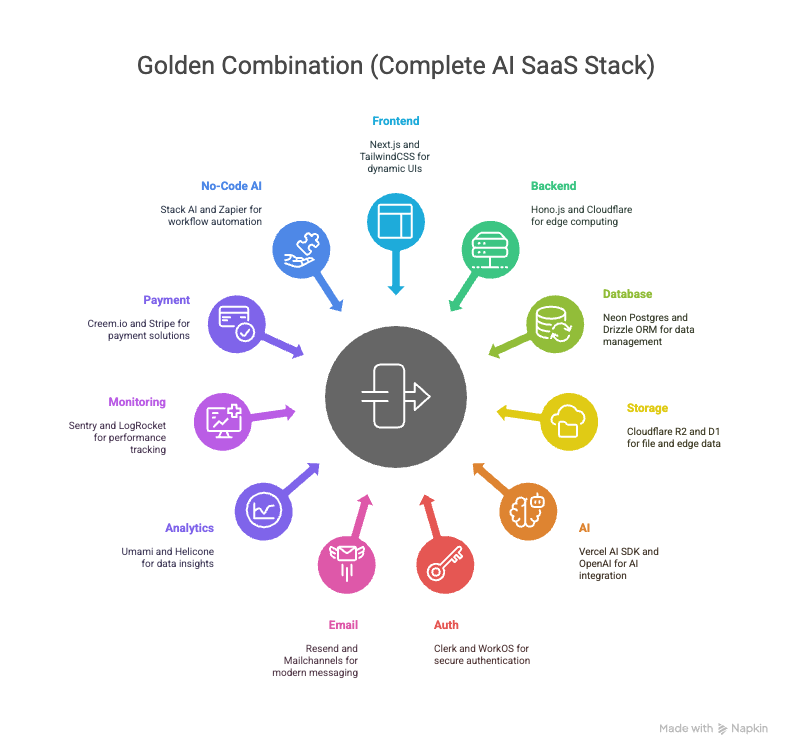
Cost-Effective Combination (MVP Projects)
Frontend: Next.js + TailwindCSS + shadcn/ui
Backend: Next.js API Routes + Edge Functions
Database: Neon (free tier) + Prisma
AI: OpenAI API + basic cost monitoring
Auth: Auth.js + social login
Email: Resend (free tier)
Analytics: Plausible (self-hosted) / Umami
Storage: Cloudflare R2
Payment: Creem.io
Enterprise Combination (B2B SaaS)
Frontend: Next.js + shadcn/ui + Mantine UI (complex interfaces)
Backend: Hono.js + Cloudflare Workers + Durable Objects
Database: Neon Pro + Drizzle ORM + multi-region backup
AI: Together AI + Langchain + private model integration
Auth: WorkOS (SSO) + Clerk (end users)
Email: Resend Pro + custom domain
Analytics: Professional analytics + complete AI monitoring stack
Observability: Helicone + Sentry + custom dashboards
Compliance: Audit logs + data governance + explainable AI
Embrace the AI Era, But Stay Rational:
AI is a tool, not the purpose. Focus on creating real value for users
Start simple, progressively increase AI feature complexity
Emphasize data and privacy protection as long-term competitive advantages
Maintain tech stack flexibility, the AI field changes rapidly
2025 indie developers need to become "AI Product Managers": Understanding both technical implementation and AI capability boundaries, while most importantly, understanding users' real needs.
Most importantly: Taking action beats perfect planning. Choose an AI application scenario, quickly build an MVP, and learn and iterate through practice. 2025 belongs to indie developers who can effectively combine AI capabilities with user value.