Personal product / Source-backed knowledge
ReadSmart
Read the idea. Follow the evidence.
A technical-topic reader that connects continuous reading, recursive knowledge maps, and source references. Move from a source to the cards it supports, then explore a linked subtopic without losing the wider context.
- My contribution
- My personal product, focused on topic reading, evidence connections, and application data boundaries. It extends an existing starter and uses established rendering, authentication, and storage libraries.
- Current status
- Public topic reader
- Built with
- Next.js, TypeScript, Cloudflare Workers, D1, R2, Drizzle
The problem.
After reading a summary, a technical reader can still be unsure how concepts connect, which source supports a statement, or where the evidence is incomplete. A reference list alone does not solve that navigation problem.
What I worked on.
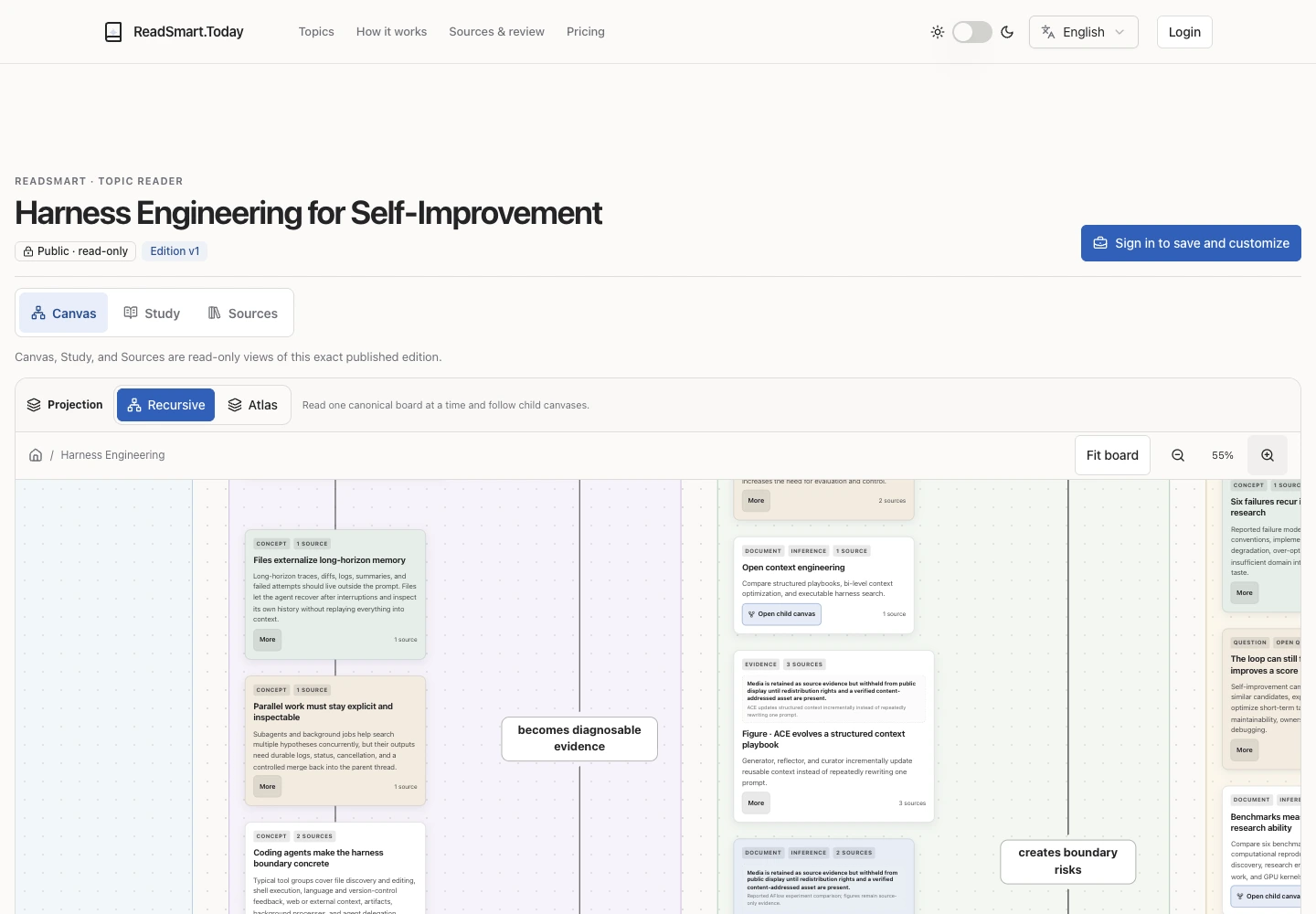
- Connected structured reading, source inspection, and recursive Canvas navigation around a shared topic edition.
- Linked cited-by relationships to specific knowledge cards and their source inspector.
- Kept verification limits and unavailable media visible instead of presenting every source as fully confirmed.
- Developed public-edition and personal-workspace boundaries, including source preservation and revision-aware save rules.
Follow a claim back to its context.
Start with a published topic
Open a topic from the public library and read its explanation in Study, with chapters and source references close to the text.
Inspect the source and its connections
Sources shows which cards cite a reference. A cited-by link returns to the corresponding knowledge card rather than leaving the reference as an isolated bibliography entry.
Read the evidence beside the card
The Canvas inspector exposes source context and verification limits. Unverified or uncertain material remains visibly qualified.
Go deeper, then return to the overview
Linked child canvases let the reader inspect a narrower mechanism and return to the parent topic without treating every detail as another unrelated page.
The reader can move between an explanation, its evidence, and the knowledge structure that gives it context.
The public English topic workflow was exercised in the review. Acquisition or matching labels do not establish that every research conclusion or excerpt has been independently verified.
The actual interface.
Under the hood.
- One topic identity, several reading views
- Next.js routes resolve a shared topic edition into Canvas, Study, and Sources. Document, edition, language, and focus identity are carried through navigation instead of maintaining three unrelated copies of the content.
- Source-aware application data
- Source anchors connect references to specific knowledge nodes. Projection and study-compilation rules retain uncertainty, while media publication checks can withhold material that does not meet the required conditions.
- Ownership and concurrent saves
- The Cloudflare-backed application separates public editions from personal workspaces. Server-side ownership checks and revision-based saves protect that boundary; D1 and R2 persistence paths have code and local rule-test evidence, not a claimed production save walkthrough here.
Decisions behind the interface.
Shared content identity instead of parallel readers
Views are projections of the same topic rather than three separate content authorities. The benefit is continuity; the cost is handling edition, language, permission, and missing-content states consistently.
Show the evidence boundary, even when it is incomplete
Uncertainty and media restrictions remain part of the interface. This makes the reading experience less seamless, but avoids presenting a polished synthesis as independently verified source material.
Separate a personal copy from the public edition
Ownership and revision checks support personal research without overwriting the public original. Upstream changes do not automatically merge into a private copy, so version and conflict handling remain explicit work.
Where it stands.
The review exercised the public English Canvas, Study, Sources, and evidence-return flow, plus selected Chinese reading views. Personal workspace saves, paid AI, PDF operations, and large-map performance were not verified end to end.
Available to explore
- Public topic editions with Canvas, Study, and Sources
- Source-to-card navigation in the reviewed English topic
- Child-canvas exploration and visible evidence limitations
Still evolving
Public editions are read-only. Personal editing requires account and feature access. Some checks and authoring tools are disabled or limited; automatic research-to-node updates remain a proposed direction, not an available continuous-update system.
Future direction
Make returning to a topic and understanding its changes easier, without losing source lineage or mixing proposed updates with a published edition.
Why I keep building it.
Good RCA depends on being able to trace a statement back to evidence. ReadSmart applies that instinct to technical reading: inspect the explanation, inspect its support, and keep uncertainty visible.
This is my personal product, separate from my professional banking-support work.